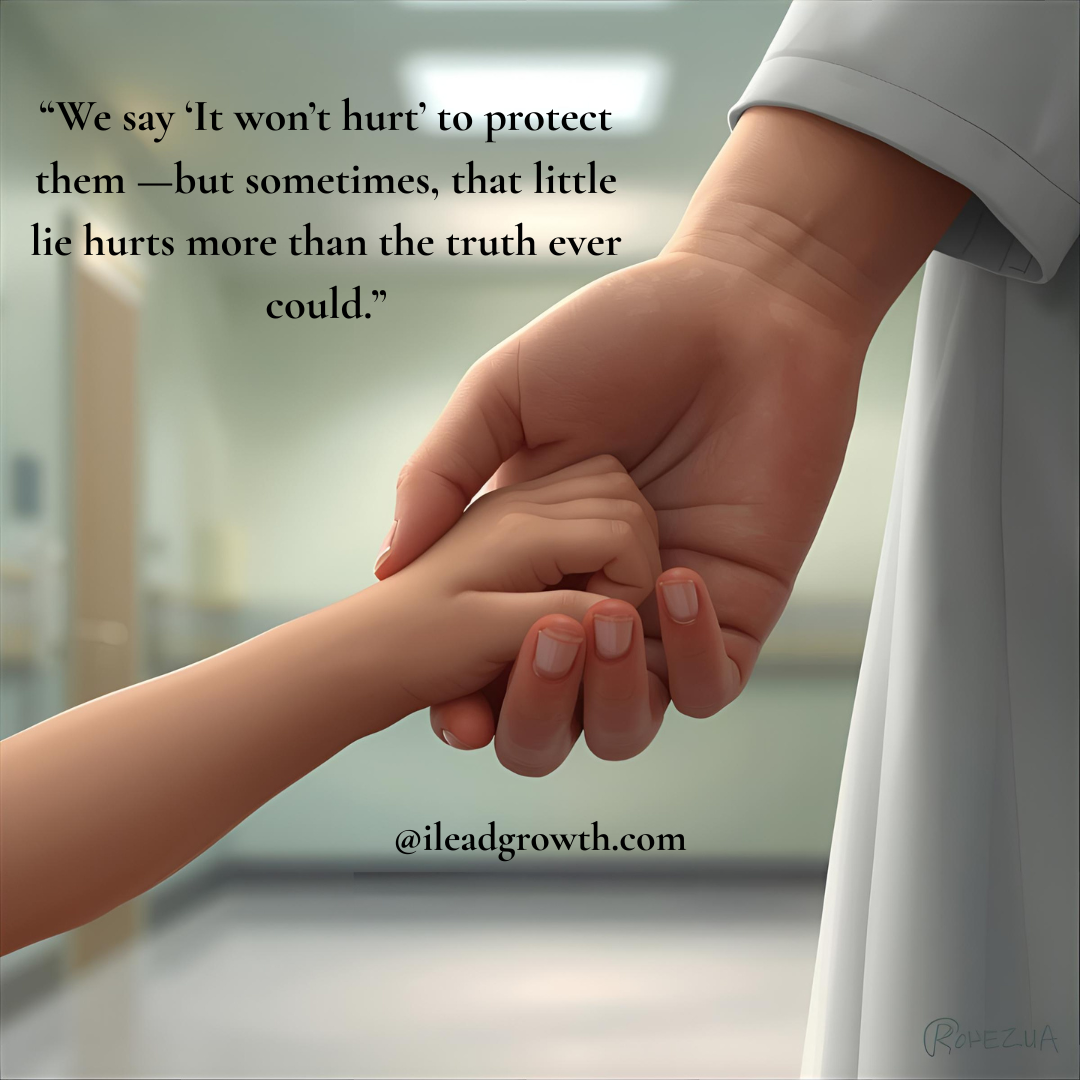
A phlebotomist shares real-life stories of parents who lie to comfort their children before blood tests — and explains how these “harmless” lies can quietly erode trust and resilience, while showing what truthful love looks like instead.
Every day in the lab, I meet brave little faces — some smiling, some trembling — waiting for their turn. And almost every day, I also meet their parents’ anxious eyes.
As a phlebotomist, I’m the one holding the needle. I see the full spectrum of emotion play out in just a few minutes: the child’s curiosity, fear, resistance, tears — and the parent’s mixture of guilt, worry, and helplessness.
But there’s one moment that repeats itself so often, it’s impossible not to notice.
It’s the moment when a parent leans down and whispers to their child:
“Don’t worry, they’re not going to prick you.”
And then they look at me, silently asking me to play along.
I understand why — it’s hard to watch your child’s body tense with fear, their eyes welling with tears. You want to make it easier for them, and maybe for yourself too. But each time I see it happen, I can’t help but wonder: What are we really teaching our children when we do this?
Why parents lie — and why it makes sense (at first)
Parents who lie about needles aren’t bad parents. They’re loving parents doing what instinct tells them — protect the child from fear and pain.
They want calm, cooperation, and peace.
But if we look deeper, these small lies often protect the parent’s peace more than the child’s wellbeing. They spare adults from having to face the crying or the panic — but they rob the child of something far more valuable: the chance to learn that fear can be faced honestly and safely.
What the child actually learns
Children might be young, but they are experts at sensing truth.
When “It won’t hurt” turns into “It did,” here’s what quietly happens in their minds:
- Trust cracks. They begin to doubt whether Mum or Dad’s comfort words are true.
- Fear multiplies. The next visit isn’t just scary because of the needle — it’s scary because they don’t know who to believe.
- Lying feels justified. They learn that dishonesty is acceptable if the intention is good.
- Courage is lost. They miss out on learning that bravery isn’t the absence of fear — it’s feeling scared and doing it anyway.
These are subtle lessons, but they matter. Every small experience builds part of a child’s sense of safety, honesty, and emotional strength.
What honesty sounds like
Honesty doesn’t have to be harsh. It can be gentle, steady, and comforting. It might sound like this:
“Yes, they’ll use a small needle to take a bit of blood. It might sting for a few seconds, but then it’s done. I’ll be right here with you the whole time.”
That kind of truth-telling builds three lifelong skills:
- Trust — your child learns your words match reality.
- Resilience — they discover they can handle discomfort.
- Safety — they realize fear doesn’t mean they’re alone.
And afterward, affirm their courage:
“You were scared, but you did it anyway. That’s what brave means.”
That simple truth helps your child rewrite fear into strength.
The long-term gift of truthful parenting
When small, well-intentioned lies add up over time, children start to internalize uncertainty. They may grow into anxious or avoidant adults who fear not just pain, but being deceived by those they trust.
But when children grow up with gentle honesty, they develop a much stronger foundation. They learn:
- That truth and safety can coexist.
- That fear is survivable.
- That they can trust both others and themselves.
That’s the real peace every parent hopes to give.
To every parent who’s ever said, “It won’t hurt”
Please don’t feel blamed. I know the love behind those words. I’ve seen it every day in the lab — parents clutching small hands, wishing they could take the pain instead.
But maybe next time, try a different kind of protection — one rooted in truth.
You can say:
“Last time I said it wouldn’t hurt, and it did. I’m sorry I didn’t tell you the truth. I’ll always tell you what’s real, even if it’s hard, because I know you’re strong enough to handle it.”
That single moment of honesty can rebuild trust stronger than before.
The takeaway
Telling the truth doesn’t make the pain worse.
It makes the world safer for your child to live in.
Because someday, when life brings bigger needles — heartbreak, disappointment, loss — your child will already know:
“I can trust the people I love. I can face what’s hard. And I’ll be okay.”
About the Author
Odhiambo J. Omondi is a practicing phlebotomist and healthcare professional who has spent years working with children and families in clinical settings. Through daily encounters in the lab, they’ve learned that the gentlest form of care isn’t in hiding the truth — it’s in helping children face it with honesty, courage, and trust.